
Is the image in the Tomb of Ankhmahor in Saqqara, Egypt really evidence for reflexology?
Many reflexologists are taught that the origins of reflexology can be traced back thousands of years, with one of the most frequently cited examples being the image found in the Tomb of Ankhmahor in Saqqara, Egypt. But what does this image actually tell us, and does it provide evidence of reflexology?
In this video, I explore why we need to be careful when interpreting historical evidence and ask what information we would need before confidently describing an ancient image as evidence of reflexology.
The image shows what appears to be people working on the hands and feet, and it is frequently described within reflexology education as evidence that reflexology was practised in Ancient Egypt.
But does this image really demonstrate the existence of reflexology?
This is an important question because there is a difference between working on the feet and reflexology as we understand it today.
Throughout history, many cultures have used massage, touch, and manual therapies for wellbeing. It is entirely plausible that people recognised that touching and working the feet could have therapeutic benefits. The feet contain a large number of nerve endings, are involved in movement and balance, and caring for them may influence comfort, relaxation, and general wellbeing.
However, if we are claiming that a historical image represents reflexology, we need to ask a further question:
What evidence would show that the feet were being worked with the intention of affecting other areas of the body?
Why would a reflexology foot map matter?
One of the features that distinguishes reflexology from general foot massage is the concept that specific areas of the feet correspond with specific areas or systems of the body.
Modern reflexology charts show maps of the feet, suggesting that working particular areas of the foot may influence corresponding parts of the body. While reflexologists may debate the details of different maps and approaches, the existence of some form of mapping system is central to how many people define reflexology.
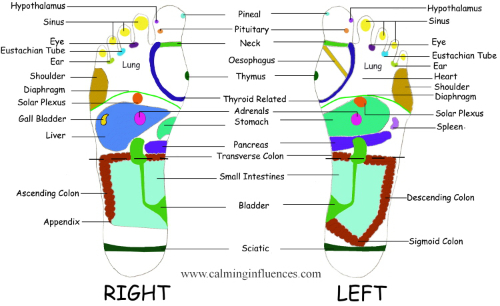
 Fancy a free Footmap? https://calminginfluences.learnworlds.com/course/reflexology-foot-map
Therefore, when looking back through history, a foot map—or written evidence describing a relationship between areas of the foot and other parts of the body—would provide much stronger evidence that a practice was recognisably reflexology.
Without this information, an image of someone working on the feet only tells us that foot treatment may have existed. It does not necessarily tell us why the feet were being worked, what the intended therapeutic effect was, or whether there was a belief that the feet represented a map of the body.
Why clear definitions matter for the future of reflexology
The question of what makes something “reflexology” is not only relevant when we look back at its history—it is also important when we consider the future of reflexology research and practice.
During my doctoral research, I explored how reflexology interventions are described in published research studies. One of the challenges identified was that reflexology is not always reported in enough detail for others to fully understand what was actually delivered.
For example, a research paper may state that participants received “reflexology”, but this does not necessarily tell us important details such as:
- Which areas of the body were treated?
- Was the treatment performed on the feet, hands, or both?
- What techniques were used?
- How long did the treatment last?
- Who delivered the intervention?
- What was the underlying rationale behind the approach?
Without this information, it becomes difficult to compare studies, understand what aspects of reflexology may contribute to outcomes, or apply research findings confidently in practice.
Interestingly, this brings us back to the question of reflexology’s origins. If we look at an ancient image showing someone working on the feet, we can identify that foot treatment may have taken place—but we cannot know whether it was reflexology without understanding the principles behind that treatment.
The same principle applies today. If we want reflexology to be recognised as a credible and well-understood therapy, we need to be able to clearly describe what reflexology is, how it is delivered, and the rationale behind the approach.
A stronger evidence base does not come from protecting every traditional belief without question. It comes from being curious, transparent, and willing to examine the details.
By understanding our history more accurately and improving how we describe modern reflexology, we can help ensure that the profession continues to develop in a way that is both respectful of tradition and aligned with good scientific practice.
The importance of separating history from interpretation
This does not mean the Ancient Egyptian image is unimportant. It is a fascinating example of early manual therapy and demonstrates that people valued touch and bodywork thousands of years ago.
The challenge is that historical evidence needs to be interpreted carefully. A picture showing foot manipulation does not automatically prove that reflexology existed in the same form that we recognise today.
As reflexologists, it is important that we respect the traditions that have shaped our profession while also being willing to examine the evidence behind the stories we tell.
A strong profession is not built on unquestioned assumptions—it is built on curiosity, critical thinking, and a willingness to ask better questions.
Perhaps the most useful question is not:
“Is this the first evidence of reflexology?”
but rather:
“What evidence would we need to confidently say that this was reflexology?”
Reflexology is a gentle, calming therapy focused on supporting relaxation and overall wellbeing. It is not about diagnosing or treating illness, but about giving the body time and space to unwind.
Final Thought
Free Videos on YouTube
If you like videos and would like to see more free reflexology based videos, check out my YouTube channel:
https://www.youtube.com/@TheReflexologyMentor
I am currently creating a series of videos exploring the different approaches and styles of reflexology practised around the world. If you found this discussion interesting, you may enjoy following the series as we look at the similarities, differences, and unique perspectives within reflexology practice.
Training with The Reflexology Mentor
If you would like train with The Reflexology Mentor check out my list of courses on my website and my learning platform:
Website: https://www.calminginfluences.com/
Learning Platform: https://calminginfluences.learnworlds.com/
Continuing the conversation
Whether you watched the video, read the blog, or both, thank you for spending your time with me and do get in touch if you have any questions or if there are any types of videos you would find really helpful.
Dr Jackie