
The secret is about feeling the reflexology reflexes and using the maps as a guide
If you’ve ever looked at different reflexology foot maps and wondered why they don’t all match, you’re not alone. One of the biggest questions I hear from students and qualified reflexologists is:
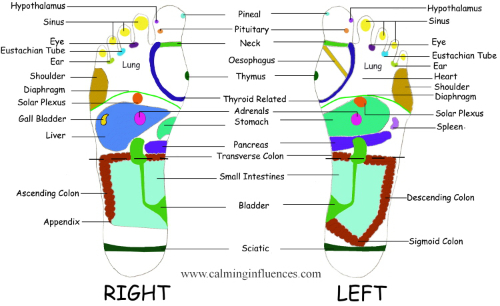
 Fancy a free Footmap? https://calminginfluences.learnworlds.com/course/reflexology-foot-map
“Which foot map is the correct one?”
The honest answer is that there isn’t a single universally accepted reflexology map. Different training schools, teachers, and traditions have developed their own interpretations over many decades. While the general locations of many reflexes are similar, you’ll often notice small differences in positioning and boundaries.
For many practitioners, this can feel confusing, particularly when they’re just starting out. Fortunately, finding reflexes is about much more than memorising a picture.
Watch the video
Reflexology maps are a guide, not a GPS
A foot map is an incredibly useful learning tool, but it should be viewed as exactly that, a guide.
Every client’s feet are unique. Their anatomy, foot shape, muscle tone, skin texture, and tissue quality all differ. If you rely solely on a printed map, you may miss important information that is right beneath your fingers.
As your experience grows, you’ll begin to use the map as a starting point rather than a set of fixed coordinates.
So, how do you actually find a reflex?
The key is to understand what the reflex feels like, not just where it is supposed to be.
This is one of the biggest transitions practitioners make as they become more experienced. Instead of thinking:
“The kidney reflex should be exactly here.”
You begin thinking:
“This is the approximate area. Now let me explore the tissues and see what I can feel.”
Developing this tactile awareness allows you to identify subtle differences in the tissues that simply cannot be seen on a foot map.
Learning to feel the tissues
One of the most valuable skills in reflexology is palpation, the ability to assess tissues through touch.
As you work across the foot, some areas may feel:
- Grainy or sandy
- Slightly crystalline
- Firmer than the surrounding tissue
- Softer or more congested
- Tender or sensitive
- Smooth and relaxed
These sensations don’t necessarily indicate a medical condition, but they do provide information that can help guide your treatment.
The more feet you work on, the more familiar these different tissue qualities become.
Using anatomy to guide your treatment
Rather than relying entirely on a foot map, it also helps to understand the anatomy that sits behind the reflex.
In the video, I use the shoulder, thyroid, and kidney reflexes as examples.
When you understand where these structures are in the body and how the reflex maps relate to that anatomy, it becomes much easier to make sense of slight variations between different charts.
Instead of memorising hundreds of individual points, you’re developing clinical reasoning.
Confidence comes with practice
Many students worry that they are “missing the reflex.”
The reality is that confidence develops through repeated practice.
Every treatment gives you another opportunity to compare:
- What the map suggests
- What your fingers can feel
- How the tissues respond during treatment
- How clients respond over time
This combination of observation, touch, and reflection is what gradually builds confidence.
Don’t be afraid of different foot maps
Seeing different reflexology maps can initially be frustrating, but it can also be helpful.
Comparing maps encourages you to think critically about reflex locations instead of relying on rote learning. It helps you appreciate that reflexology is a practical skill developed through experience, not simply an exercise in memorisation.
Ultimately, the foot map gets you into the right area. Your hands help you find the reflex.
Keep developing your touch
Touch is one of the most important tools a reflexologist has. The more you practise thumb walking, palpation, and tissue assessment, the more sensitive your fingers become.
With time, you’ll rely less on looking at a chart and more on what your hands are telling you.
That’s when reflexology starts to become far more intuitive and rewarding.
Final thoughts
Free Videos on YouTube
If you like videos and would like to see more free reflexology based videos, check out my YouTube channel:
https://www.youtube.com/@TheReflexologyMentor
Training with The Reflexology Mentor
If you would like train with The Reflexology Mentor check out my list of courses on my website and my learning platform:
Website: https://www.calminginfluences.com/
Learning Platform: https://calminginfluences.learnworlds.com/
Continuing the conversation
Whether you watched the video, read the blog, or both, thank you for spending your time with me and do get in touch if you have any questions or if there are any types of videos you would find really helpful.
Dr Jackie